Fall 2026 Colloquia
American Indian & Indigenous Studies hosts a monthly colloquium series featuring researchers and community leaders who share their research, scholarship, and community-engaged projects. The series fosters interdisciplinary collaboration and highlights the diverse work taking place across the field of American Indian & Indigenous Studies.
Colloquia are free and open to all, including students, faculty, staff, and community members. No registration is required.
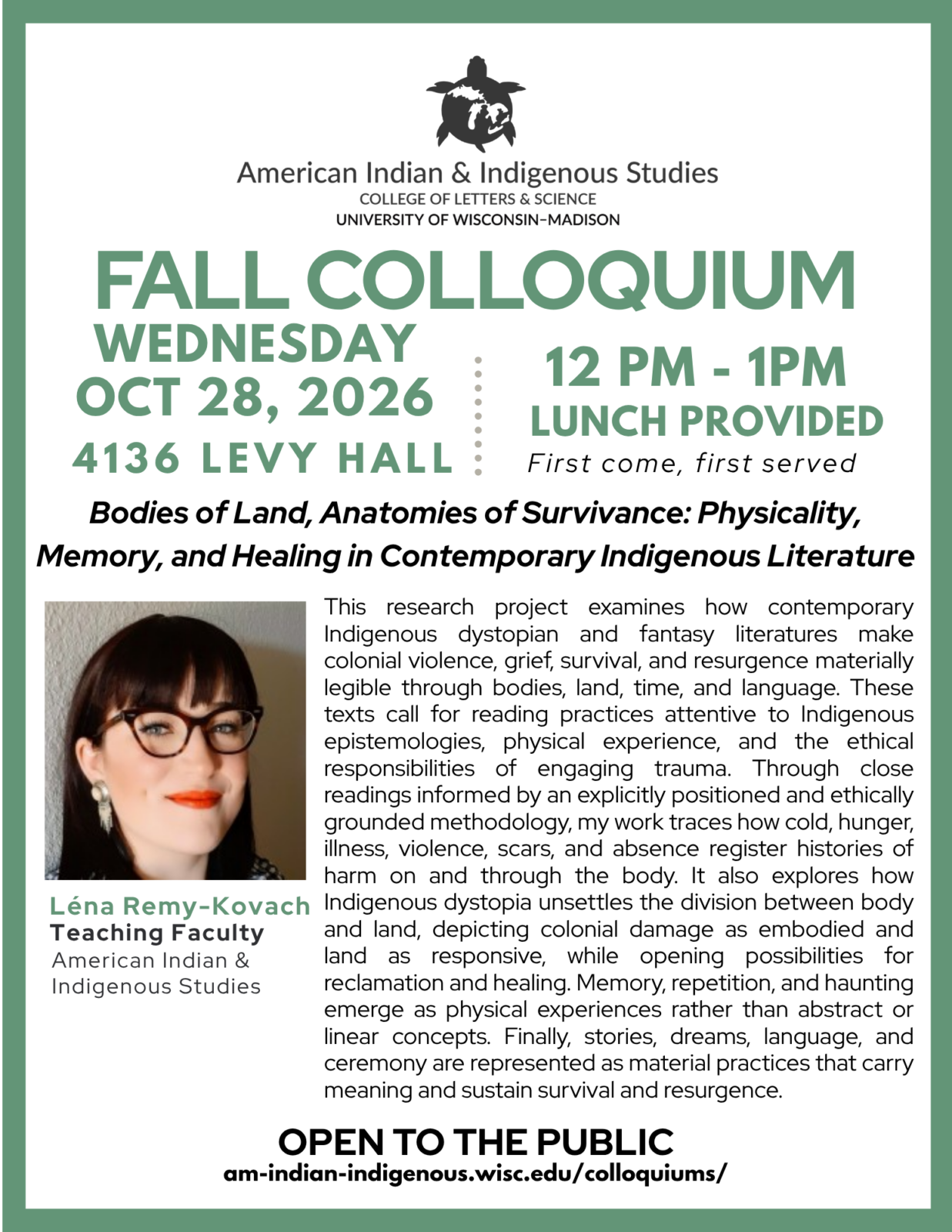
Join us Wednesday, October 28, 2026 for the next AIIS Colloquium!
“Bodies of Land, Anatomies of Survivance: Physicality, Memory, and
Healing in Contemporary Indigenous Literature “
AIIS Teaching Faculty Dr. Léna Remy-Kovach
12:00 PM- 1:00 PM
4136 Levy Hall

October
-
October 28
November
-
November 18
Past Colloquia
Explore past AIIS colloquia featuring scholars, researchers, artists, and community leaders working across American Indian & Indigenous Studies and related fields.
Fall 2026
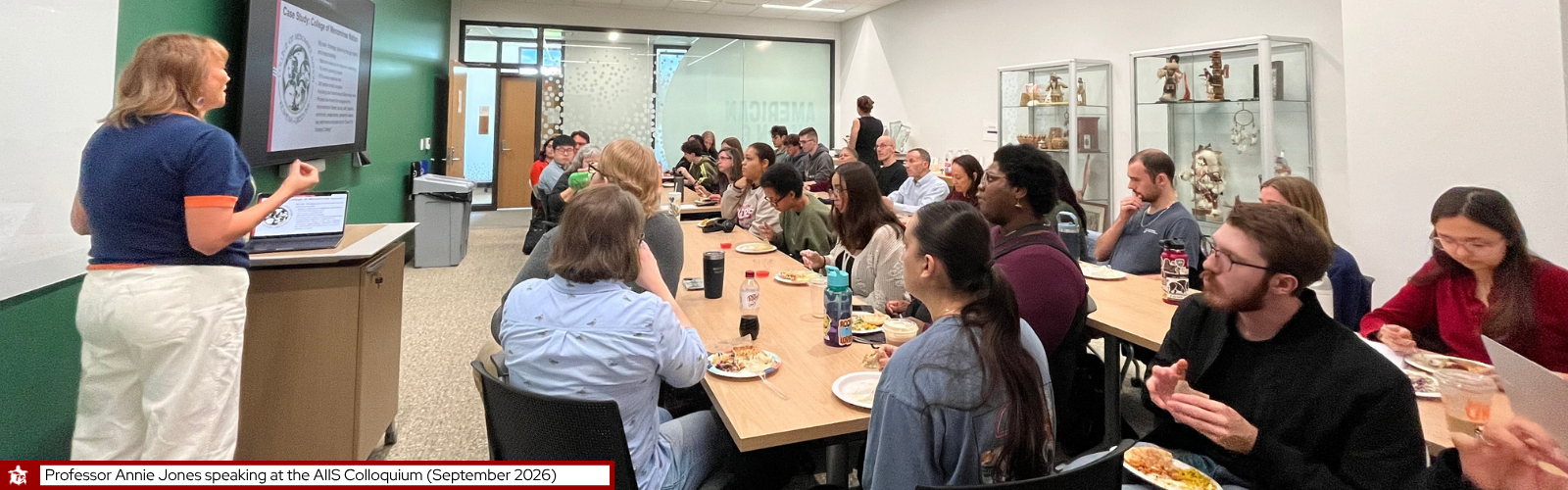
Annie Jones, September 23, 2026
Leading from Culture: Incorporating Indigenous Ways of Knowing, Being, and Doing into your Work
Indigenous ways of knowing, being, and doing offer important ways of thinking about how we approach leadership, research, planning, evaluation, and community engagement. This presentation explores what it means to lead from culture and to recognize culture as a living knowledge system that can shape the questions we ask, the relationships we build and the ways we define success. Drawing on examples from work with Tribal Nations and communities, including the use of the medicine wheel as a culturally grounded methodology, the presentation considers how centering relationships, reciprocity, responsibility, and multiple ways of knowing can change not only what we do, but how and why we do it.
John Hitchcock, February 25, 2026
We Are Defined by the Beat
For over three decades, John Hitchcock has transformed the sonic and cultural rhythms of his Oklahoma homeland into a distinct visual language. An enrolled member of the Kiowa Tribe of Oklahoma with Comanche and Northern European ancestry, Hitchcock merges personal expression with references to intertribal powwows, the Wichita Mountain landscape of his youth, and the symbols and languages of Great Plains Native populations. Working across printmaking, neon, textiles, sound, and video, he merges traditional and contemporary art forms to pay homage to his ancestors, confront histories of Indigenous displacement and trauma, and celebrate community, resilience, and survival. For this talk, he will speak about five bodies of work, including Flatlander, Bury the Hatchet, Blanket Songs, Soundscapes, and Celebration.
Ian Baird, April 29, 2026
Indigenous Self-Determination and Government Recognition: Thinking about Challenges in Thailand and Beyond
One major advancement of the international Indigenous Peoples movement has been the recognition of “self-determination,” formalized in the 2007 United Nations Declaration on the Rights of Indigenous Peoples (UNDRIP). This principle affirms Indigenous rights to define their identities and practices, challenging longstanding colonial control over decision-making. However, tensions arise between maintaining self-determination and seeking state recognition and material support, which often require fitting into state-defined categories. While such recognition can increase visibility, it may also impose constraints. Drawing on examples from mainland Southeast Asia, particularly Thailand, this paper argues that Indigenous struggles often rely on state recognition while striving to preserve autonomy.
Fall 2025
Shaun Marcott, September 24, 2025
Engaging Community College Students Through a Field-Based Volcanoes and Ice Summer Program (VISP) in Central Oregon
In the summers of 2022-2025, several institutions partnered to host the Volcanoes and Ice Summer Program (VISP), a week-long immersive field course designed for Portland Community College students. Using the unique backdrop of volcanoes, glaciers, and related geologic deposits in the Oregon Cascades near Sunriver, VISP employed established field- and place-based pedagogical approaches (e.g., Pfeifer et al., 2020; Semken et al., 2017) to deepen student learning and engagement. The program was part of an international outreach effort alternating annually between the Cascade Range, USA and the Southern Volcanic Zone, Chile through collaborations with Portland Community College and Universidad de la Frontera in Temuco. This presentation will focus on VISP-Oregon, highlighting program design and implementation, goals and learning outcomes, and suggestions to build similar programs based on results from student-evaluations from three iterations of the program.
Sissel Schroeder, October 22, 2025
Ancient Dugout Canoes of Wisconsin: Indigenous Collaboration for Knowledge Production
The Wisconsin Dugout Canoe Survey Project, including the Lake Mendota dugouts, has been successful in part because of the collaborative partnership among the principal research team: Professor Sissel Schroeder (University of Wisconsin–Madison), Tamara Thomsen (Wisconsin Historical Society), Larry Plucinski (Bad River Tribe of Lake Superior Chippewa), Bill Quackenbush (Ho-Chunk Nation), and Michael Weimann (USDA Forest Products Laboratory). More than 120 dugout canoes have been reported from Wisconsin, ranging in age from the early 20th century to more than 5,000 years old. The stories these dugouts reveal are helping to challenge and refine historically based understandings of dugout canoe technology, significantly expanding knowledge of American Indian maritime history and highlighting the importance of these watercraft within the transportation networks of the land we today call Wisconsin.
Ahna Skop, November 19, 2025
One cell divides into three things: the curious story of the midbody remnant and it’s implications in cancer diagnostics
Dr. Ahna Skop is an internationally recognized geneticist, cell biologist, artist, and science communicator at the University of Wisconsin–Madison. She holds joint appointments in Genetics, Cell and Regenerative Biology, Life Sciences Communication, and the Division of the Arts. Renowned for her pioneering research on the molecular mechanisms of cell division—particularly the role of midbody remnants (MBRs) as RNA-rich organelles—Dr. Skop’s work has illuminated fundamental processes underlying cancer and neurodevelopmental disorders. As Chief Scientific Officer and co-founder of aMBR Genomics, Dr. Skop is translating key discoveries from her laboratory into innovative diagnostic technologies for cancer and neurodegenerative disease. A passionate advocate for STEAM education, she integrates the arts into science as a curator, author, and educator. Her creative works include Genetic Reflections: A Coloring Book and Lab Culture: A Recipe for Innovation in Science. Dr. Skop’s achievements have been recognized with the Presidential Early Career Award for Scientists and Engineers (PECASE), the AAAS Remarkable Women in Science honor, and numerous teaching awards. She is also a leader in STEM inclusion, spearheading programs to expand access and representation across the scientific community.
Spring 2025
Eve Emshwiller, February 21, 2025
Diversity of Crop Plants Domesticated and Conserved by Indigenous Andean Peoples
This talk introduces some of the many crop plants that were domesticated in the Andean Mountain region by the ancestors of the peoples of the Inca empire. Some of these crops are now grown and eaten around the world, whereas others are less well known. Tuber crops of four different plant families were domesticated and are still cultivated in the Andean region, one of which is called “oca” (Oxalis tuberosa). Research in my lab studies the genetic diversity of oca, which has been cared for by generations of Quechua and Aymara agriculturists, and also related wild species of Oxalis, in the hopes of providing information in service of the conservation of this diversity for future generations.
Thomas DuBois, March 7, 2025
Wiigiwaam, Wêkewam, Goahti: Facilitating Inter-Indigenous Visits Between Wisconsin and Sápmi
The talk explores the work of a public humanities folklorist, particularly in facilitating meetings and collaborations between Sámi artists, activists, and educators and their Indigenous counterparts in Wisconsin. It will outline how “action research” can work, particularly in communities striving to decolonize, and the role that universities need to play in reversing the corrosive processes of colonization, past and present.
Luke Zoet, April 18, 2025
Centering Indigenous and Place-Based Ways of Knowing in Geoscience: Undergraduate Research Experiences
Geoscience is a discipline that seeks to understand the world and its processes across vast time and spatial scales. By applying this knowledge to environmental contexts, challenges, and solutions, it can serve as a valuable tool in Indigenous environmental decision-making. However, Indigenous knowledge is often marginalized in research and curricular contexts, limiting engagement at multiple levels. As the College of Menominee Nation develops its Geoscience program, a key goal is to create a curriculum that supports Indigenous students and allies while fostering culturally relevant learning in the sciences. In collaboration with University of Wisconsin–Madison researchers, graduate and undergraduate students, and community members, CMN students participated in a geoscience summer undergraduate research experience centered on Indigenous and place-based ways of knowing. We will share lessons learned from this experience and explore how this model can enhance Indigenous communities’ capacity to exercise sovereignty while expanding the geoscience knowledge paradigm to meaningfully integrate Indigenous knowledge. We hope to spark interest in intentional and value-based collaboration and Place-based learning in (and for) one’s community.
Fall 2024
Bill Gartner, September 27, 2024
A Brief History of Mąąmąceqtaw (Menominee) Raised Field Agriculture: Ancestral Guidance for a Sustainable and Sovereign Future
Many prehistorians view the Menominee heartland in northeast Wisconsin as a marginal environment for traditional maize agriculture. Historic accounts, penned during the Fur Trade and Treaty eras, often characterize Mamaceqtaw peoples as hunter-gatherer-fishers. However, Mamaceqtaw oral traditions detail how the tribe acquired crops such as maize and squash. I have been part of the Menominee Indian Tribe of Wisconsin’s (MITW) culture camp program for the past 13 years. As part of the MITW culture camp program, we conducted archaeological excavations and soil analyses at multiple, relict raised field sites in the Central Wolf River valley. Mamaceqtaw peoples started growing maize around ca 900 AD, and they successfully raised maize, squash, sunflower, and other plants through several subsequent periods of environmental change. Oftentimes, the end result of ancestral Mamaceqtaw agriculture was more fertile soil. Thus, Mamaceqtaw peoples are the original organic and sustainable maize agriculturalists in Wisconsin. Ancestral Mamaceqtaw agricultural innovations inform current MITW food sovereignty efforts.
John Hall, October 18, 2024
Osceola’s Ghost: Thomas Sidney Jesup and the Legacy of Removal
Prof. John W. Hall will revisit one of the most infamous instances in the annals of American warfare: the capture of the Seminole war leader Osceola under a white flag of truce. While many Americans simultaneously sanctioned indiscriminate violence against Native peoples, this incident nevertheless ruined the reputation of the officer who ordered the capture, Thomas Sidney Jesup. In exploring this paradox, Hall will shed light on the contorted logic of settler colonialism in the Early Republic and the roles society demanded of different characters in a tragedy that unfolded in real time.
Stefan Aune, December 6, 2024
Indian Wars Everywhere: Colonial Violence and the Shadow Doctrines of Empire
References to the Indian Wars, those conflicts that accompanied US continental expansion, suffuse American military history. From Black Hawk helicopters to the exclamation “Geronimo” used by paratroopers jumping from airplanes, words and images referring to Indians have been indelibly linked with warfare. In Indian Wars Everywhere, Stefan Aune shows how these resonances signal a deeper history, one in which the Indian Wars function as a shadow doctrine that influences US military violence. The United States’ formative acts of colonial violence persist in the actions, imaginations, and stories that have facilitated the spread of American empire, from the “savage wars” of the nineteenth century to the counterinsurgencies of the Global War on Terror. Ranging across centuries and continents, Indian Wars Everywhere considers what it means for the conquest of Native peoples to be deemed a success that can be used as a blueprint for modern warfare.
Spring 2024
Matt Villeneuve, February 23, 2024
Habeas Corpus and American Indian Boarding Schools: Indigenous Self-Determination in Body and Mind, 1880–1903
This talk examines the history of Native people’s usage of habeas corpus to resist family separation employed as part of a system of boarding schooling between 1885 and 1903. Using sources drawn from Petitioning For Freedom: Habeas Corpus in the American West, 1812-1924, a public digital history collection created by Dr. Katrina Phillips, this paper analyzes a collection of habeas corpus petitions made by Native petitioners on behalf of young Native people in boarding schools. Using habeas, petitioners challenged boarding school’s legal paternalism, coded as masculine, fatherly authority wielded by government officials over not just Native children, but Indigenous adults. This legal paternalism was often challenged by Native people using the vocabulary of schooling, where Native people demanded petitions by asserting their capacity to make decisions about the education of their kin. These habeas corpus cases are therefore a crucial part of the boarding school history, American Indian and Indigenous history, and the history of U.S. education.
Carolee Dodge Francis, March 15, 2024
Navigating the Intersection of Type 2 Diabetes & COVID-19 Among Native American and Alaska Native Communities
This presentation addresses the intricate tapestry of causation for type 2 diabetes which often begins early in life, as historical, social, economic, and environmental health determinants intersect with biological and behavioral factors. Stressors associated with colonization (e.g., trauma, loss of lands, relocation to reservations, food insecurity, poverty), compounded across centuries and linked to trends in obesity and type 2 diabetes in recent decades. Native Americans and Alaska Natives in the United States face disproportionately high rates of Type 2 diabetes. This chronic condition affects both health and well-being, which put the Native American population more vulnerable to other health challenges. The emergence of the COVID-19 pandemic further complicated and still complicates matters. The intersection of both Type 2 diabetes and COVID-19 through the lens of education, prevention, and research will be discussed.
Leah Horowitz, April 12, 2024
Environmental Governance of the Dakota Access Pipeline
The Dakota Access Pipeline (DAPL), an oil pipeline that runs just over a half-mile from the Standing Rock Reservation, represents yet another example of industrial expansion’s disproportionate impacts on Indigenous Peoples. This talk presents the results of three recent studies in which I used a “studying-up” approach to examine élites’ role in DAPL’s environmental governance – the multi-stakeholder management of harms such as pollution and the risk of industrial disaster. I apply an original “triple-helix” theoretical framework to explore the intertwining of ideologies, policies, and power relations in these governance processes, and in particular whether and how they did (or, more often, did not) account for Environmental Justice. This research uncovers successes and challenges for the #DefundDAPL movement, reasons for the US Army Corps of Engineers’ (USACE) failure to adequately consider cultural heritage in their permitting processes for DAPL, and ways that USACE exacerbated various forms of environmental injustice through their Environmental Analysis.
Fall 2023
Kasey Keeler, September 29, 2023
American Indians and the American Dream: Policies, Place, and Property in Minnesota
Understanding the processes and policies of urbanization and
suburbanization in American Indian communities
Examining the long history of urbanization and suburbanization of Indian communities in Minnesota, American Indians and the American Dream investigates the ways American Indians accessed homeownership, working with and against federal policy, underscoring American Indian peoples’ unequal and exclusionary access to the way of life known as the American dream.
Kai Pyle, October 27, 2023
Two-Spirit Love and War as Indigenous Diplomacy
This talk explores one chapter of Dr. Pyle’s current project on Indigenous gender diversity in the 19th century, focusing on the Ojibwe Two-Spirit figure named Ozaawindib. Using concepts in the Ojibwe language, the talk will show how Ozaawindib’s seemingly individual pursuits of marriage and glory in war actually reflect important roles that Two-Spirit people could hold in Ojibwe diplomacy and kinship.
Margaret Huettl
Our Lands and Our People: (Re)Storying Anishinaabe Sovereignty, 1854–1954
Dr. Huettl, Lac Courte Oreilles Ojibweg, is a scholar of Native American history and North American West. Her research delves into Indigenous sovereignty and settler colonialism in a transnational context. Her current project focuses on Ojibwe or Anishinaabe sovereignty with a central emphasis on Anishinaabe ways of knowing.
Spring 2022
Em Loerzel, February 4, 2022
The Inclusion and Exclusion of Native American Women in Sex Trafficking Literature: A Scoping Review
The original peoples of Turtle Island possess a unique risk of being sex trafficked, due to the insidious impact of colonization. Sex trafficking of Native American women and girls, though grossly understudied and researched, has been an issue since the beginning of the colonization of America, and is defined as the force, exploitation, and coercion into non-consensual sex work of an individual facilitated by a third party. My analysis focuses on eight studies that included Native American women in sample demographics in sex trafficking literature. We will cover key concepts, study characteristics, and implications.
Kai Pyle, March 4, 2022
Folks Like Us: Recovering Queer, Trans, and Two-Spirit Ojibwe Language
Despite intense colonial efforts to destroy traditions of gender and sexual diversity, queer and trans Indigenous people have nonetheless managed to hold onto memories of the history of “folks like us.” By following the records of several words for nonbinary genders in archival documents and oral tradition, this talk will trace the legacy of kinship that exists between past and present queer, trans, and Two-Spirit Anishinaabe people. These efforts in turn are vital for ensuring a future for Two-Spirit folks within Indigenous communities.
Baligh Ben Taleb, April 22, 2022
Newe Segobia: How Two Western Shoshone Sisters Fought for Their Land and Treaty Rights
Baligh Ben Taleb is currently an ACLS Postdoctoral Fellow in Race, Ethnicity, and Indigeneity, at the University of Wisconsin–Madison. He earned his Ph.D. in History at the University of Nebraska-Lincoln (UNL), an M.A. also from UNL, and B.A. (Honors) in English and American Studies at the University of Tunis. He is at work on a book project that examines the history of the Indian Claims Commission (1946-1978) and its implications for American Indians’ longstanding efforts to regain land that they have lost over several centuries.
Fall 2021
Samantha Majhor, November 12, 2021
Truth and Reclamation: Understanding the Indian Boarding School Archive Through the Native Literary Record
Assistant Professor of English Marquette University
Ashley Minner, December 10, 2021
Revisiting “The Reservation” of East Baltimore
The place now known as Baltimore, like the rest of what is now known as the United States of America, has always been home to Native peoples. Baltimore is part of the ancestral homelands of the Piscataway and the Susquehannock, and a diverse host of American Indian folks from many nations have passed through or lived here at different times — and still do! In the mid-twentieth century, thousands of Lumbee Indians and members of other tribal nations migrated to Baltimore City, seeking jobs and a better quality of life. On the east side of town, they created a vibrant, intertribal American Indian community, which they affectionately referred to as their “reservation” in its heyday. Through ethnography and archival research, and in collaboration with her elders, Ashley Minner has been mapping East Baltimore’s historic “reservation.” She sees this as an urgent project of reclamation of history, space, and belonging.
Fall 2020
Patrick J. Jung, September 18, 2020
Ho-Chunk Prehistory, Protohistory, and Ethnogenesis: New Approaches to Old Questions
The prehistory and protohistory of the Ho-Chunk tribe have been fiercely debated by ethnohistorians, cultural anthropologists, and archaeologists for more than half a century. Only scattered documentary sources exist concerning the Puans, the ancestors of the historic Ho-Chunk people. Recent archaeological discoveries, a better understanding of the French documentary sources, and Ho-Chunk oral traditions provide a new framework through which to interpret the prehistory and protohistory of the Ho-Chunk people as well as their ethnogenesis in the latter half of the seventeenth century after the destruction and collapse of the earlier Puans society.
Spring 2020
Grace Bulltail, February 14, 2020
Who Stands to Benefit and Lose?: Coal Producing Tribes, Natural Resource Development, Land Use, & Sovereignty
In the U.S., there are two primary coal producing tribes, the Navajo Nation and Crow Tribe which rely on the royalties from leasing and developing their coal resources for a significant portion of their respective tribal operating budgets. The declining coal economy has led to rash, poorly thought out deals, and tribes as well as tribal landowners will need to remain vigilant in the current political environment with loosening regulatory protections.
Mariaelena Huambachano, March 6, 2020
Research Through Indigenous Eyes: The Khipu Model
Mariaelena Huambachano is an Indigenous scholar native of Peru with strong cultural connections to Aotearoa New Zealand. She is a food sovereignty and environmental justice advocate as well as an active member of the United Nations Permanent Forum on Indigenous Issues. Her research focuses on Indigenous transnational comparative studies at the interface between culture heritage and agrobiodiversity proving a new approach to understanding traditional knowledge, biocultural heritage and public policies.
Fall 2019
Bernard Perley, September 20, 2019
“Having Reservations”: Reimagining Life in the New World
Dr. Bernard C. Perley is a member of the Maliseet Nation from Tobique First Nation, New Brunswick, Canada. He is an associate professor in the Anthropology department at the University of Wisconsin-Milwaukee where he teaches courses in linguistic anthropology and American Indian Studies. He was recently (academic year 2018-2019) a visiting associate professor of Anthropology and the Gordon Russell visiting associate professor of Native American Studies at Dartmouth.
Margaret Noodin, October 18, 2019
Wenji-Anishinaabe’ Biiamaan (Why I Write in Anishinaabemowin): Reflections on a Career of Poetry and Nonfiction
Margaret Noodin received an MFA in Creative Writing and a PhD in Linguistics from the University of Minnesota. She is currently a Professor at the University of Wisconsin-Milwaukee where she also serves as the Director of the Electa Quinney Institute for American Indian Education. She is the author of Bawaajimo: A Dialect of Dreams in Anishinaabe Language and Literature and Weweni, a collection of bilingual poems in Ojibwe and English. Her poems have been anthologized in Sing: Poetry from the Indigenous Americas, Poetry Magazine, The Michigan Quarterly Review and Yellow Medicine Review.